
When life gives you black locust flowers… no, seriously, these black locust fritters are such a fun way to celebrate spring. A healthy spin on my mother’s recipe, these ones feature whole grain flour fermented with care. They are delicately seasoned with honey and, of course, packed with flowers. Yum!

The tree behind the fritters
In every locale I’ve lived both in France and the US, I’ve found at least one black locust tree. So it probably won’t be very hard for you to locate one. In fact, its native range is believed to be the Appalachia region. From there, it spread to many parts of the world, including France. In Paris, it happens to be the city’s oldest tree.
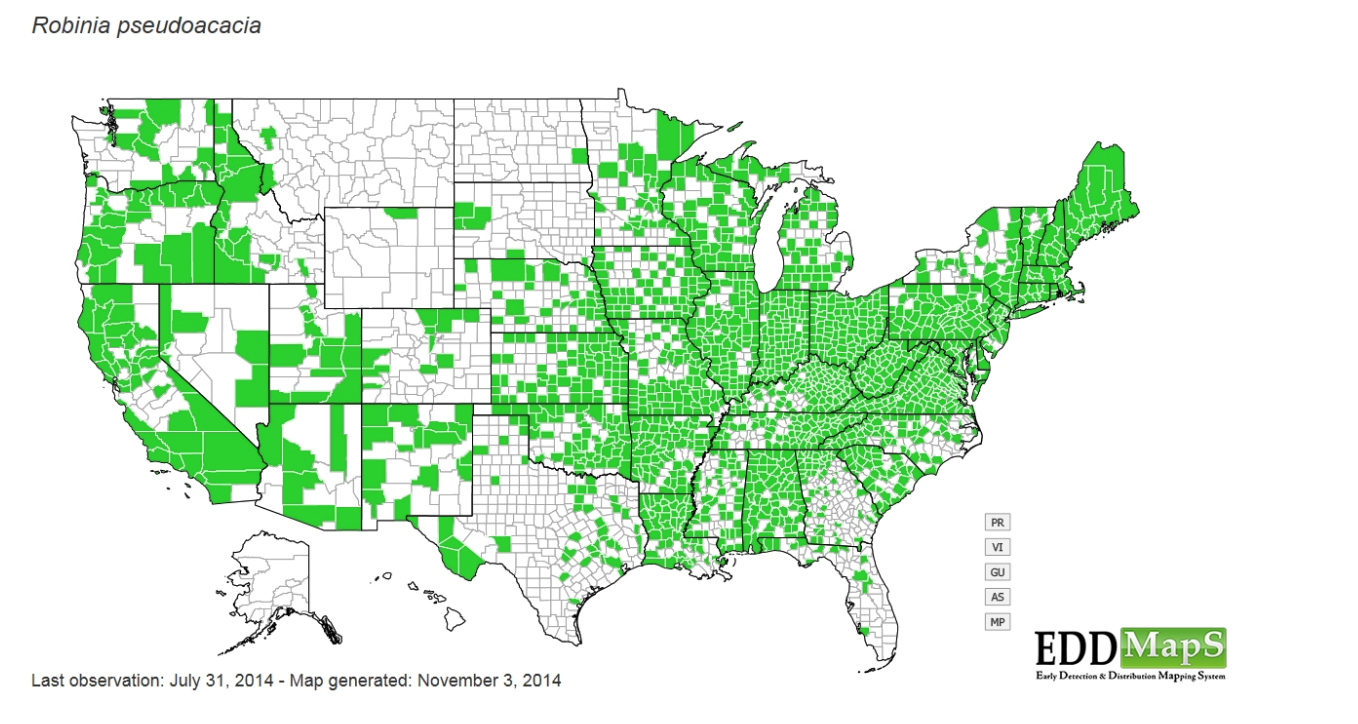
This map will give you an idea of the black locust’s current distribution across the US — it’s abundant!
Growing up, Black Locust Fritters were known to me as beignets de fleurs d’acacia, after the tree’s latin name, Robinia Pseudoacacia. It’s one of those recipes I only make once a year. Maybe twice in a good year. Probably because by the time I notice the blooming, the flowers are already fading — it all happens very fast.

Sometime in mid- to late spring, the tree blooms all at once. From every branch hang clusters of creamy-white flowers that sway in the wind and vibrate with bees all day long. In the span of just a few weeks — maybe less if there’s a big rain — the plump, pea-like flowers wither away. Soon after, they fall with a steady cadence, aided by each gust of wind. A most melancholic spring snow.
Black locusts are considered a nuisance by many ecologists because of their rapid growth and tendency to soak up lots of water. Some people though, like the revolutionary Japanese farmer Masanobu Fukuoka, have praised black locust for its ability to recolonize damaged sites and fix atmospheric nitrogen in the soil — an essential process for much of plant life.

Black locust identification
Start with location and get down to details. As you’d expect of a plant deemed invasive, black locust often shows up on roadsides and damaged areas.
It grows tall with lanky limbs and cast the most elegant of dappled shades. Its light green oval leaves are pinnate, growing on both sides of thin stems. In late summer, they turn bright yellow before falling and exuding the smell of old books.
Another identifying factor for black locust is the presence of thorns on the branches. At my grandparents’ place used to be lots of black locusts, and we kids loved running barefoot through the dry grass… That didn’t stop us, though. It might have even added to the bucolic charm!
Despite the black locust’s aggressive traits, I always feel blessed when I cross paths with a black locust, especially one in full bloom — un acacia en fleur.
Sometimes it’s the sight of the tall frame covered in creamy flowers that clues me in. Other times, it’s the sweet fragrance of a thousand blooms wafting from a block away. Then, I’m like a dog sensing a barbecue. My nose perks up, my focus narrows, and I’m guided by an invisible hand to the stunning show.

From my family to yours
Once, you’ve found a tree, it doesn’t take too many flowers to make some tasty fritters. Which is a good thing, because most are too high up to reach anyway. Pick the most plump, fragrant ones; they taste sweeter. The faded ones taste more like… peas. You’ll only need about 8 clusters for this recipe, but if you end up with extras, toss them in a salad or on any dessert — they’re good to eat raw too.
My mother is never afraid to eat plants she forages. She’s the one to credit for giving me this tradition. When I was growing up, she’d make a yearly batch of fritters for us. There was a big tree in the neighborhood that we could see from our room. And from afar, we could tell if it was flush with flowers.
My mother would fry the beignets, aka French donuts, in a generous pool of oil. She’d take the clusters, holding them by the stem, and dip them in batter. The batter was nothing fancy if I remember. One of those recipes she always shared by saying, “Oh, just put some flour and some water — you’ll see how much.”


About this recipe
Over the years, I’ve seen recipes involving sparkling water, beer, and whatnot. From my own experience, beer, even pale ale, is just too strong for the delicate flowers. And to me, the point here is not exactly to make something gourmet; it’s to make something simple, homey, and fun.
I used rye flour in this recipe. Simply because I had it on hand — very much in my mom’s thrifty spirit. Rye flour’s gluten is not elastic enough to make artisan bread, so I use it in batters, and it’s perfect. It also varies up the grains a bit. I know it can be easy to get stuck on an endless rotation of wheat, rice, and corn. The flour gets fermented with the help of a little raw apple cider vinegar. A simple technique I first learned about in this great article by the Nourishing Home, How to Soak Grains for Optimal Nutrition.
Instead of frying in a large pool of oil though, I cook the fritters in a little olive oil. They’re maybe not as crispy, but they’re tasty. Arguably, these black locust fritters are more like mini pancakes bites. So what?

I also forgo adding sugar into the dough as is typical. Rather, I save some raw honey to spread on at the end, after the fritters have cooled down slightly. That way the honey’s enzymes are preserved. As Sally Fallon reminds us in her amazing book Nourishing Traditions, raw honey helps us digest starches. A treat with benefits!
When it comes to the type of honey to use, any raw and unfiltered honey is great. Your local farmers market or grocery store are probably good places to find some. But if you’ve never had acacia honey (in other words, black locust honey), you must try it once in your lifetime. It’s a pretty, light gold and has just the right amount of sweetness.
Bon appétit!
P.S.: Please don’t die. Do your own research before picking any plant for food and make sure you have the right one.

More recipes
- For an extra dose of flowers in your life, try this Lush Dandelion Salad.
- For more spring energy, try this Portobello, Cheddar, and Pea Shoots Sandwich.
- For a snack more on the savory side, try this Buttery Gomasio Popcorn.
If you make the recipe, let us know! Drop a comment below or tag @frenchfrimousse on Instagram.

Fermented Black Locust Fritters – Beignets de fleurs d’acacia fermentés
Equipment
- frying pan
Ingredients
- 8 black locust flower clusters
- 1 cup organic whole grain flour – rye, spelt, einkorn, or white whole wheat
- 1 cup filtered water
- 1 tsp raw apple cider vinegar
- ½ tsp baking soda
- 2 pinches unrefined salt
- 1 tbsp oil for frying – I used extra virgin olive oil
- 2 tbsp raw, unfiltered honey – or to taste
Instructions
- Collect some fresh black locust flowers or ask someone to collect some for you. The more plump and fragrant the flowers, the better. Avoid wilted ones. Let the flowers sit in a strainer or basket to allow any small creature to come out. Then gently lift the flowers out. You can also give them a quick rinse if you'd like. Drain well.

- In a medium bowl, add 1 cup of flour (spoon the flour into the measuring cup so that the flour remains light and fluffy). Add 1 cup of water, 1 tsp of apple cider vinegar and mix well.
- Strip the flowers from the main stem. Discard the stem and add the flowers to the batter. Mix again.
- Cover the batter with a lid or plate and let sit at room temperature for 7 hours minimum and up to 24 hours.
- When ready to fry the fritters, add 1/2 tsp baking soda and a couple pinches of salt to the batter. Give it a final mix.
- Heat up your favorite pan with a little oil over medium-low heat.
- When the oil is hot, spoon the batter onto the hot pan a tablespoon at a time. Let cook for a couple minutes or until the edges darken, flip, and cook for a couple more. Transfer to a dish and repeat with the remaining batter.
- Add a dab of raw honey onto each fritter once they have cooled slightly so as to not compromise the enzymes in the honey. Enjoy right away.


Leave a Reply